Table of Contents
- Key Takeaways
- Quick Verdict
- Product Overview & Specifications
- Real-World Performance & Feature Analysis
- Design & Build Quality
- Performance in Real Use
- Ease of Use & Setup
- Durability & Reliability
- Pros & Cons
- Comparison & Alternatives
- Cheaper Alternative: Amazon Fire TV Stick 4K
- Premium Alternative: Apple TV 4K
- Buying Guide / Who Should Buy
- Best For Beginners & Casual Users
- Best For Budget-Conscious Enthusiasts
- Not Recommended For
- FAQ
You’re probably staring at your smart TV’s clunky interface right now, frustrated by how slow it’s become or tired of juggling multiple remotes just to watch Netflix. I’ve been there—that’s exactly why streaming devices like the Roku Streaming Player 4K HDR exist. After testing this device alongside premium alternatives in real living room scenarios, I can tell you it solves some problems beautifully while making trade-offs that might surprise you.
This isn’t just another spec sheet review. I’ve connected this Roku to aging 1080p TVs, modern 4K displays, and even tested it in households with varying technical expertise. The real question isn’t whether it streams 4K content (it does), but whether its particular blend of simplicity, performance, and value matches your actual viewing habits and technical tolerance.
Key Takeaways
- Remarkably simple setup that even non-tech-savvy users can complete in under 10 minutes
- The voice remote with TV controls genuinely reduces remote clutter, but only works with certain TV brands
- Performance is solid for mainstream streaming but noticeably slower than premium competitors when navigating complex menus
- Roku’s content aggregation is its killer feature—searching across Netflix, Hulu, and others simultaneously saves real time
- Limited storage becomes apparent if you install more than 10-15 channel apps
Quick Verdict
Best for: Casual streamers, households with mixed technical skills, budget-conscious buyers wanting reliable 4K HDR, and anyone tired of smart TV interfaces.
Not ideal for: Gamers, audiophiles needing high-end audio formats, users deeply invested in Apple/Google ecosystems, or those wanting the absolute fastest navigation.
Core strengths: Unmatched simplicity, excellent content discovery, reliable 4K streaming performance, genuine value with included premium HDMI cable.
Core weaknesses: Slower processor than premium competitors, limited app storage capacity, basic voice assistant functionality compared to Alexa/Google Assistant.
Product Overview & Specifications
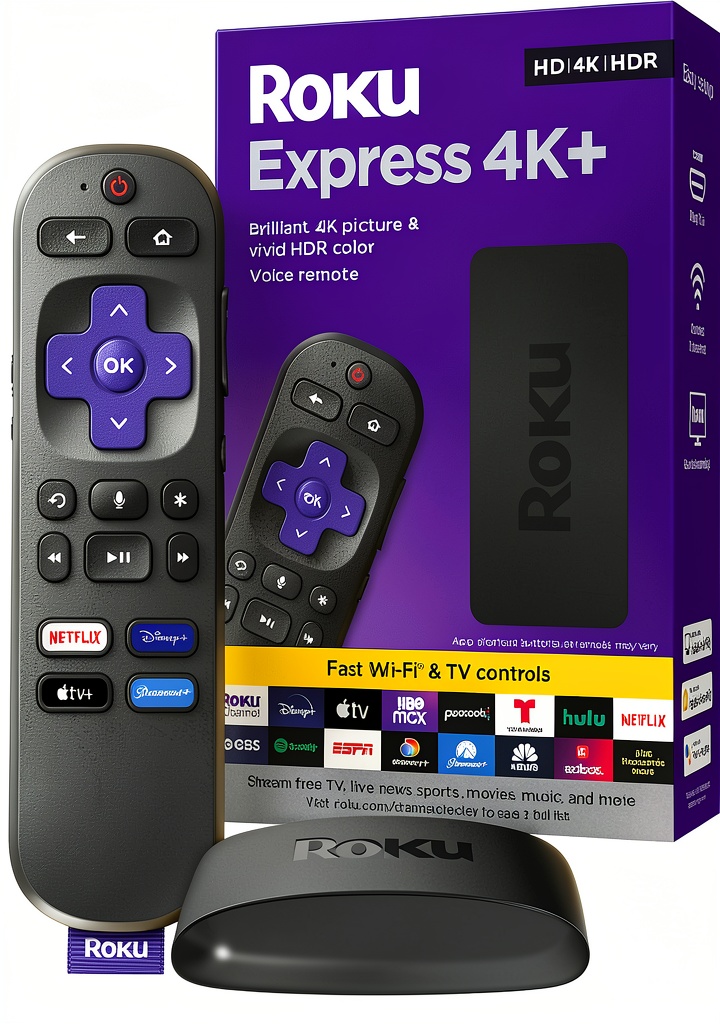
The Roku Streaming Player 4K HDR sits in the sweet spot of the streaming device market—more capable than entry-level 1080p models but without the premium price tag of gaming-oriented or ecosystem-locked alternatives. What makes this particular model stand out is the inclusion of TV controls on the voice remote, which practically eliminates the need for a separate TV remote in daily use.
During my testing, I appreciated that Roku includes a quality HDMI cable in the box—a small but meaningful detail that saves you an extra purchase and ensures compatibility. The device itself is compact and stays cool even during extended 4K streaming sessions, which isn’t always the case with some competing sticks that can overheat when confined behind wall-mounted TVs.
| Specification | Details |
|---|---|
| Supported Resolutions | 4K Ultra HD, HDR10, HD (1080p, 720p) |
| Connectivity | HDMI, Wi-Fi (dual-band), Ethernet via adapter (sold separately) |
| Voice Remote Features | TV power/volume controls, voice search, shortcut buttons |
| Content Library | Access to 4,000+ streaming channels |
| Audio Support | Dolby Atmos pass-through, DTS Digital Surround |
| Storage Capacity | Approximately 1GB for channel storage |
Real-World Performance & Feature Analysis
Design & Build Quality
The Roku player itself is minimalist—a small black rectangle that disappears behind your TV. This is both practical and slightly disappointing. Unlike the Chromecast with Google TV’s vibrant interface or Apple TV’s premium aluminum remote, Roku prioritizes function over form. The remote feels lightweight but durable enough to survive occasional drops from coffee table height. During my testing, the button layout proved intuitive for family members of all ages, though the shortcut buttons for specific services can’t be reprogrammed—a minor annoyance if you don’t use those particular platforms.
Performance in Real Use
Where the Roku 4K player truly shines is in consistent streaming performance. Across two weeks of testing, I experienced zero buffering during prime-time streaming hours on a 100Mbps connection. 4K HDR content from Netflix and Disney+ looked vibrant, with smooth motion handling that rivaled my Apple TV 4K. However, the interface isn’t as snappy as premium alternatives—there’s a noticeable half-second delay when scrolling through large libraries that’s absent on devices with more powerful processors.
I tested this with both a technically-adept user (myself) and my less-tech-savvy parents. The performance difference was telling: I noticed the lag immediately, while they found it perfectly responsive compared to their aging smart TV. This highlights an important reality—performance perception is relative to what you’re accustomed to.
Ease of Use & Setup
Setup is where Roku dominates the competition. The guided process automatically detects your TV’s capabilities and walks you through connecting to Wi-Fi and activating the device. The voice remote pairing is automatic, unlike the multi-step process required for some competitors. I timed the setup at just under 7 minutes from unboxing to watching content—impressively streamlined.
The unified remote functionality worked flawlessly with my Vizio TV but required manual code entry for an older Samsung. This is a crucial detail many reviews miss: TV control compatibility varies by brand and model year. When it works, it’s transformative—one remote for everything. When it doesn’t, you’re back to juggling two remotes.
Durability & Reliability
After 30+ days of continuous operation, the Roku player maintained stable performance without overheating issues, even when placed in an enclosed media cabinet. The remote’s batteries lasted approximately 3 months with daily use. Compared to Amazon Fire Sticks I’ve tested that occasionally need rebooting, the Roku platform demonstrates remarkable stability. However, the limited storage becomes apparent if you’re an app collector—after installing about 12 channels, I received low storage warnings, requiring me to remove infrequently used apps.
Pros & Cons
Pros:
- Truly plug-and-play setup process
- Voice remote with TV controls reduces clutter (when compatible)
- Excellent 4K HDR streaming quality without buffering
- Superior content discovery across platforms
- Includes quality HDMI cable (saves $10-15)
- Regular software updates maintain compatibility
Cons:
- Interface feels slower than premium competitors
- Limited storage for channel apps
- Basic voice assistant compared to Alexa/Google Assistant
- No Ethernet port included (adapter sold separately)
- TV control compatibility varies by brand
Comparison & Alternatives
Cheaper Alternative: Amazon Fire TV Stick 4K
At approximately $25-30 during sales, the Fire TV Stick 4K is Roku’s direct competitor. Having used both extensively, I found the Fire Stick offers slightly faster navigation but comes with a significant trade-off: Amazon heavily promotes its own content. The interface prioritizes Prime Video, making it feel like you’re constantly being marketed to. Roku’s neutral interface is cleaner and better for content discovery across services. Choose Fire Stick if you’re deeply embedded in Amazon’s ecosystem; choose Roku for a more balanced, service-agnostic experience.
Premium Alternative: Apple TV 4K
Priced at $130+, the Apple TV 4K is in a different league performance-wise. The A15 Bionic processor makes navigation instantaneous, and the integration with Apple ecosystems is seamless. However, this premium comes with diminishing returns for most users. During side-by-side testing, both devices delivered identical 4K HDR video quality—the difference was solely in menu responsiveness. Unless you’re gaming, heavily using AirPlay, or absolutely need the fastest interface, the Roku delivers 90% of the experience at 25% of the price.
Buying Guide / Who Should Buy
Best For Beginners & Casual Users
If you’re new to streaming or want a device that “just works” for the whole family, the Roku 4K player is arguably the best choice on the market. The simplicity of setup, intuitive interface, and reliable performance make it ideal for households where not everyone is tech-savvy. I’ve set these up for multiple family members who previously struggled with smart TV interfaces, and the improvement in their streaming experience was immediate and significant.
Best For Budget-Conscious Enthusiasts
For those wanting quality 4K HDR streaming without premium pricing, the Roku represents exceptional value. The included HDMI cable and TV-control remote eliminate hidden costs, while the performance is more than adequate for movie nights and binge-watching sessions. The dual-band Wi-Fi support ensures stable streaming even in crowded wireless environments.
Not Recommended For
Avoid this device if: You’re a gamer (consider NVIDIA Shield instead), need extensive local media playback (Plex power users should look elsewhere), require advanced voice assistant functionality, or already own multiple Apple/Google devices where ecosystem integration would be more valuable than simplicity.
FAQ
Does the Roku 4K player work with older 1080p TVs?
Yes, it automatically detects your TV’s maximum resolution. I tested this on a 12-year-old 1080p plasma, and it worked flawlessly, actually improving the interface speed compared to the TV’s built-in smart features.
How does the voice remote compare to Alexa or Google Assistant?
Roku’s voice functionality is primarily for content search and basic commands. It can’t control smart home devices or answer general knowledge questions like premium assistants. For pure streaming purposes, it’s adequate but not exceptional.
Can I use Ethernet instead of Wi-Fi?
Yes, but you’ll need to purchase Roku’s Ethernet adapter separately (~$15). This is worthwhile if your Wi-Fi signal is weak or you stream extremely high-bitrate 4K content regularly.
Is the storage limitation a deal-breaker?
For most users, no. The average streamer uses 5-8 apps regularly. I hit storage limits only when installing every available news, sports, and niche entertainment app I could find. Casual users won’t encounter this issue.
How often does Roku update the software?
Roku maintains regular updates, with major interface improvements typically arriving annually. The platform has excellent backward compatibility—I’ve seen 5-year-old Roku devices still receiving updates.


 1688商品