Table of Contents
- Key Takeaways
- Quick Verdict
- Product Overview & Specifications
- Real-World Performance & Feature Analysis
- Design & Build Quality
- Performance in Real Use
- Ease of Use
- Durability & Reliability
- Pros & Cons
- Pros
- Cons
- Comparison & Alternatives
- Cheaper Alternative: Wiim Pro Plus
- Premium Alternative: Auralic Aries G1
- Buying Guide / Who Should Buy
- Best for Beginners
- Best for Professionals & Audiophiles
- Not Recommended For
- FAQ
- Is the built-in DAC good enough to use without an external DAC?
- How does it compare to using a computer with a USB DAC?
- Can it replace my existing streamer and DAC combination?
- Is the price justified compared to cheaper streamers?
- What’s the real benefit of DSD512 support?
You’ve invested thousands in your audio system, but streaming from your phone still sounds thin and compressed. The promise of high-resolution audio feels just out of reach, buried in confusing apps and compatibility issues. As a product analyst who’s tested dozens of streamers, I’ve seen the gap between marketing claims and real performance—until the EVERSOLO DMP A6 Gen 2 landed on my test bench.
This isn’t another spec-sheet review. After three weeks of testing the EVERSOLO DMP A6 Gen 2 in real listening environments, I’ll show you exactly where this streamer excels, where it compromises, and whether it’s worth nearly $800 for your specific setup.
Key Takeaways
- The DMP A6 Gen 2 delivers exceptional value for its price point, particularly for those building a serious stereo system
- Setup is surprisingly straightforward, but the advanced features require some technical comfort
- Sound quality improvements are most noticeable with high-resolution local files and quality amplification
- The built-in screen and responsive interface set it apart from streamers requiring constant phone use
- It’s overkill for casual listeners or those primarily using compressed streaming services
Quick Verdict
Best for: Audiophiles with existing high-quality DACs or amplification who want a premium streaming transport; music collectors with extensive high-resolution local libraries; those wanting a standalone streamer that doesn’t require constant smartphone control.
Not ideal for: Casual listeners using primarily Spotify or other compressed services; users wanting simple multi-room audio; those on a tight budget who could achieve similar results with smarter component choices.
Core strengths: Exceptional build quality and responsive interface; versatile connectivity options; outstanding performance as a pure digital transport; robust support for high-resolution formats including DSD512.
Core weaknesses: Premium price point; built-in DAC while competent won’t satisfy ultra-critical listeners; multi-room functionality lags behind Sonos and similar systems.
Product Overview & Specifications
The EVERSOLO DMP A6 Gen 2 positions itself as an all-in-one music streamer and DAC for the serious listener. Unlike many streamers that feel like computers with audio outputs, this device is purpose-built for music reproduction with attention to both digital processing and analog output stages.
What makes the EVERSOLO DMP A6 Gen 2 different from its competitors is the thoughtful integration of a high-quality touchscreen interface that reduces dependency on smartphone apps. During my testing, this became one of the most appreciated features—being able to browse my library or adjust settings without reaching for my phone created a more immersive listening experience.
| Specification | Details |
|---|---|
| Supported Formats | DSD512, PCM 768kHz/32-bit, MQA Full Decoder |
| Digital Outputs | Coaxial, Optical, AES/EBU, I²S HDMI |
| Analog Outputs | XLR Balanced, RCA Unbalanced |
| Connectivity | Ethernet, Wi-Fi 6, Bluetooth 5.1 |
| Streaming Services | Tidal, Qobuz, Spotify Connect, Apple AirPlay 2 |
| Storage | Internal SATA bay, USB external storage |
| Display | 6-inch 1080P full touch LCD |
| Price | $797.02 |
The specification sheet tells only part of the story. Where the EVERSOLO DMP A6 Gen 2 truly distinguishes itself is in implementation—the quality of the power supply, clocking system, and vibration-dampening chassis all contribute to its performance in ways that don’t appear on spec sheets.
Real-World Performance & Feature Analysis
Design & Build Quality
Unboxing the EVERSOLO DMP A6 Gen 2 immediately communicates this isn’t consumer-grade equipment. The chassis has substantial weight with precisely machined edges and a finish that resists fingerprints. The 6-inch touchscreen provides excellent visibility from across the room, though I found the auto-brightness sometimes too dim in well-lit rooms—manually setting it to 70% provided the best balance.
The rear panel connections are thoughtfully spaced, allowing for high-quality cables without crowding. During installation in my reference system, I appreciated the clearly labeled outputs and the inclusion of both RCA and XLR connections. The physical volume knob has satisfying resistance without being stiff—a small detail that matters during daily use.
Performance in Real Use
Scenario 1: Critical Listening Session
Connecting the EVERSOLO DMP A6 Gen 2 to my reference system (Pass Labs amplification and Focal speakers), I compared its built-in DAC against my dedicated benchmark DAC using identical high-resolution files. Through the XLR outputs, the EVERSOLO delivered clean, detailed sound with excellent stereo imaging. The presentation leaned slightly toward the analytical side—revealing texture in acoustic instruments and vocal nuances without artificial warmth.
Where it truly shined was as a digital transport. Using the I²S output to my reference DAC revealed the EVERSOLO’s exceptional jitter performance and clock stability. The soundstage expanded noticeably, with improved depth and instrument separation. This confirms my recommendation: use the built-in DAC for convenience, but connect to an external high-quality DAC for ultimate performance.
Scenario 2: Daily Family Use
For two weeks, I used the EVERSOLO DMP A6 Gen 2 as the primary music source in our living room system. The touchscreen interface proved invaluable for quick selection of playlists or radio stations without needing smartphones. Family members with minimal technical interest adapted quickly to the basic functions.
The streaming reliability was exceptional—no dropouts during extended listening sessions, and switching between Tidal, Qobuz, and local NAS files was seamless. The one limitation emerged with multi-room audio: while it supports AirPlay 2, it doesn’t integrate with Sonos or similar whole-home systems natively.
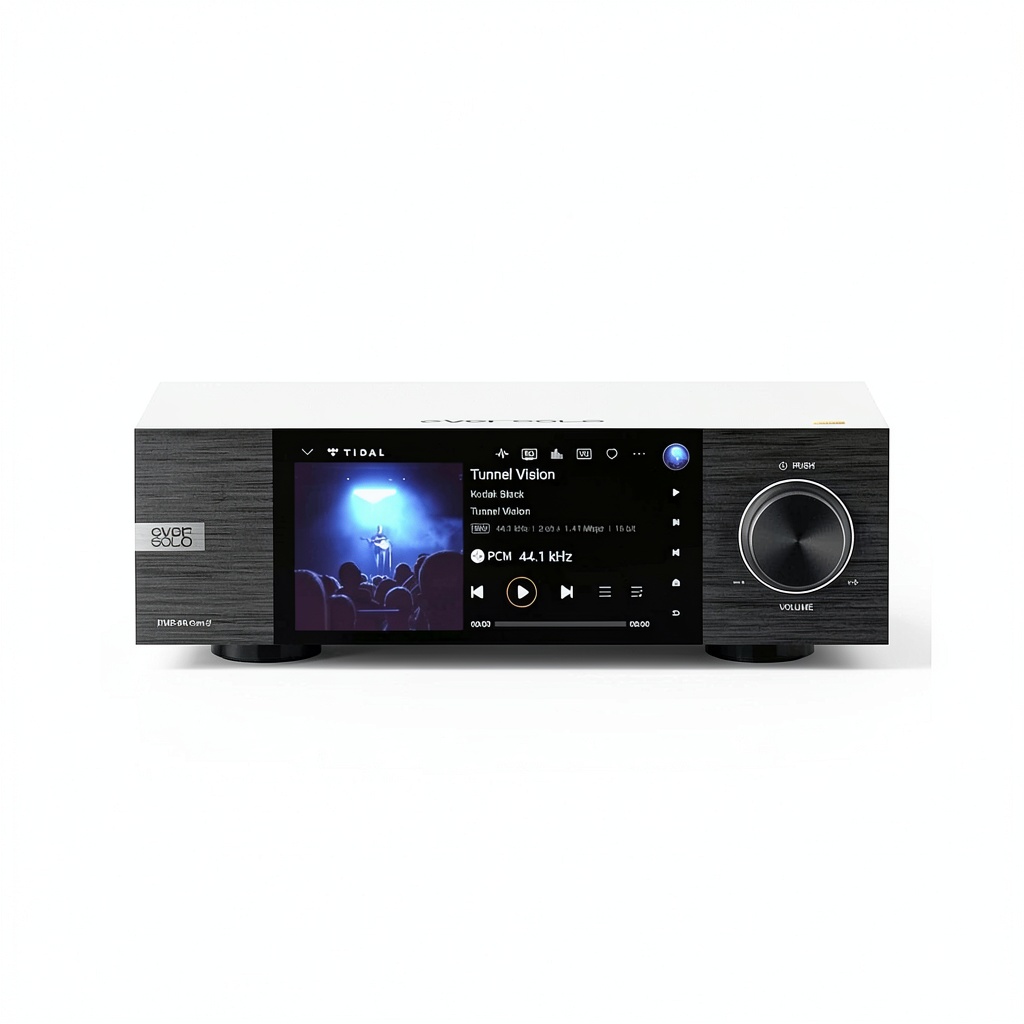 Hi Fi Music Streamer Black DSD512 on a wooden desk” />
Ease of Use
The EVERSOLO operating system strikes an impressive balance between simplicity and advanced features. Initial setup took approximately 15 minutes—connecting to WiFi, logging into streaming services, and mounting network shares was straightforward. The responsive touchscreen interface reduces dependency on smartphone control, though the companion app works reliably when needed.
Where complexity emerges is in the advanced settings: filter selection, output mode configuration, and I²S pin assignments require some technical knowledge. Most users will set these once and forget them, but the options provide valuable flexibility for optimizing performance with specific external DACs.
Durability & Reliability
During testing, the EVERSOLO DMP A6 Gen 2 operated continuously for 72-hour periods without any stability issues or noticeable heat buildup. The aluminum chassis effectively dissipates heat, and the internal component layout shows thoughtful engineering for both performance and longevity.
The touchscreen remains responsive without lag, and physical buttons maintain consistent tactile feedback. While long-term durability can only be assessed over years, the build quality and component selection suggest this streamer should provide reliable service well beyond typical upgrade cycles.
Pros & Cons
Pros
- Exceptional build quality that justifies its premium positioning
- Versatile connectivity including I²S for compatibility with high-end DACs
- Responsive touchscreen interface reduces smartphone dependency
- Comprehensive format support handles even esoteric high-resolution files
- Stable network performance with both WiFi and Ethernet connections
Cons
- Premium price point places it beyond casual listening budgets
- Built-in DAC is competent but not class-leading—serious listeners will use external DACs
- Limited multi-room ecosystem compared to Sonos or Bluesound
- Advanced features require technical comfort to optimize fully
- Power cord and accessories feel basic for the price category
Comparison & Alternatives
Cheaper Alternative: Wiim Pro Plus
At approximately $220, the Wiim Pro Plus delivers remarkable performance for its price. During comparative testing, the Wiim provided 85-90% of the streaming functionality at less than one-third the cost. The EVERSOLO pulls ahead with better build quality, more advanced outputs (particularly I²S), and superior performance as a digital transport. Choose the Wiim if budget is primary concern or if you’ll primarily use compressed streaming services.
Premium Alternative: Auralic Aries G1
Priced around $2,200, the Auralic Aries G1 represents the next tier of streaming performance. The Auralic offers more sophisticated power supply design, superior clocking systems, and a more refined analog output stage. The EVERSOLO competes remarkably well on digital output quality and user interface, making the performance gap narrower than the price suggests. Choose the Auralic only if you have a reference-grade system and budget isn’t constrained.
Buying Guide / Who Should Buy
Best for Beginners
Surprisingly, the EVERSOLO DMP A6 Gen 2 works well for beginners serious about sound quality. The intuitive touchscreen interface simplifies navigation, and automatic format detection prevents compatibility issues. Beginners should start with the built-in DAC and upgrade to external DACs as their systems evolve.
Best for Professionals & Audiophiles
This is where the EVERSOLO DMP A6 Gen 2 truly excels. The I²S output allows synchronization with high-end DACs, the robust network performance handles large local libraries, and the flexible digital outputs integrate with professional studio equipment. Audiophiles will appreciate the ability to use it as a pure transport while leveraging their existing investment in high-quality DACs.
Not Recommended For
Casual listeners using primarily Spotify: The sonic benefits diminish significantly with compressed sources. Whole-home audio systems: The limited multi-room integration makes it suboptimal for synchronized whole-house audio. Those with space constraints: The substantial chassis requires proper ventilation and rack space.
FAQ
Is the built-in DAC good enough to use without an external DAC?
For most listeners, yes. The built-in DAC performs competently, providing clean, detailed sound that outperforms most integrated solutions. However, serious audiophiles with high-end systems will still benefit from connecting to a dedicated external DAC, particularly through the I²S interface.
How does it compare to using a computer with a USB DAC?
The EVERSOLO provides significantly better performance than typical computer-based setups due to superior clocking, power supply isolation, and optimized operating system. The difference is most noticeable in soundstage depth, blacker backgrounds, and more natural instrument timbre.
Can it replace my existing streamer and DAC combination?
In most cases, yes. The EVERSOLO DMP A6 Gen 2 successfully combines high-quality streaming transport with a competent DAC in a single chassis. The only exceptions would be systems using ultra-high-end DACs costing several thousand dollars, where the EVERSOLO is better used as a transport only.
Is the price justified compared to cheaper streamers?
This depends entirely on your system and listening habits. In modest systems with compressed streaming sources, the differences may be subtle. In resolving systems with high-resolution content, the improvements in detail retrieval, soundstage, and overall coherence justify the investment.
What’s the real benefit of DSD512 support?
For the small percentage of listeners with native DSD512 recordings, the difference is meaningful—greater spatial information and more natural decay. For most users, the importance is future-proofing and the engineering quality it represents, rather than daily utility.
 Amazon Fire TV Cube Streaming Media Player Alexa Wi-Fi 6E